Corned Beef and Cabbage are a favorite combo. So why not make it a soup?
The result is a gentle but flavorful soup which might become one of your favorites. Enjoy!
Total time to prepare – Approximately 1 hour 30 minutes. Serves twelve (10-12).
Ingredients
10 cups Vegetable Broth
8 cups Beef Broth
2 Sweet Onion, diced
4 Garlic cloves, minced
!/4 cup Butter (1/2 stick)
6 Celery, chopped
4 Carrots, chopped
1 1/2 lbs Yukon Gold Potatoes, unpeeled and cubed
1 cup Barley, quick-cooking
1/2 cup Ground Mustard
2 tsp Dried Thyme
2 tsp Black Pepper
2 tsp Salt
1 1/2 lbs Corned Beef, sliced into 1/2″ pieces
10 cups Green Cabbage, or a small head, chopped.
Directions
Slice the potatoes into bite-size pieces, with the skin on. Some markets have small Yukon gold potatoes which are convenient and can be sliced into quarters. Boil for 15 minutes and set aside. This will slightly reduce the starch and enhance the flavor of the soup.
In a soup pot or large Dutch oven, add 2 cups of the vegetable broth, keep the 8 cups for later. Heat on medium.
Add onion, celery, carrots, barley and garlic and cook until softened, about 15 minutes. The instructions refer to stalks of celery and number of carrots.
Add the remaining vegetable broth, plus the beef broth. Bring to a boil while adding the cabbage, salt, thyme, pepper and mustard. After this reaches a boil, reduce heat to medium-low, cover, and stir occasionally.
Stir in the potatoes and corned beef, again return to a simmer for another 10 minutes or so, until potatoes and corned beef is heated. Taste and add more salt and pepper if this suits your taste.
Enjoy! Please subscribe for more Recipes for a Happy Life and interesting stories.
Also, perhaps you are interested in my book, Hope Landing, a story set in a small town on the Great Lakes. If you order through my website, I will sign a copy and provide free shipping.
This soup recipe is supposedly handed down from the Shakers, a religious sect that spun off from the Quakers in the mid-1700s. They aren’t around anymore since they practiced celibacy. I wonder how they thought that would work out long term.
Anyhow, the soup is souper-tasty and easy to make. You’ll likely add this recipe to your list of favorites and you won’t have to become celibate to make it!
Total time to prepare – Approximately 1 hour 30 minutes. Serves twelve (10-12).
Special Equipment Needed:
Dutch oven or stockpot
Ingredients
14 cups Chicken Broth
1 Sweet Onion, diced
4 Garlic cloves, minced
!/4 cup Butter (1/2 stick)
1 cup Heavy Whipping Cream
1 cup Celery, thinly sliced
1 1/2 cup Water
3/4 cup All-purpose flour
2 cups of Rostisserie Chicken, shredded – white or dark meat, or mixture
Salt and black pepper to taste
12 oz Egg noodles
1/4 cup Chopped Parsley
Directions
Place the diced onion, minced garlic, and thinly sliced celery into a dutch oven or stockpot with one cup of the broth. Simmer on low with no lid.
While step one is simmering, add 1 cup of broth and the butter in a small saucepan. Bring to a boil and continue boiling for 15-20 minutes until the liquid is reduced to about 1/4 cup and has the consistency of syrup. Remove from heat and gently stir in the whipping cream with a whisk or wooden spoon. Set aside. The vegetables and spices in the pot should now be tender. Add the remaining 12 cups of broth and bring to a boil. Simmer uncovered for about 15 minutes.
While the broth is simmering, shred the chicken. Do not use the skin and you may use white or dark meat, or any combination you prefer. Set aside.
Bring another large pot of water of boil, add salt and add your pasta. Cook per the package instructions. You may use any type of noodles you prefer.
Combine the water and flour in a medium bowl and whisk until smooth. You may use one of those tiny electronic frothers or immersion blender if you prefer. If you prefer your soup to be less thick, reduce the amount of flour. Stir into the pot, return to a boil and stir constantly while simmering for about 2 minutes. Your soup will begin to thicken.
Stir in the reserved cream mixture, add the shredded chicken and season to taste with salt and pepper. Keep the soup on low but DO NOT BOIL. Sprinkle the parsley over the soup.
Enjoy! and visit me at www.martyatl.com for more Recipes for a Happy Life and interesting stories.
Before the CSSA had the Dreamers League on Thursday mornings, we would often receive queries from players who could not play any other days, yet had a strong yearning to join a team. They didn’t qualify for any of our other leagues, and Wednesday morning matched their abilities, but not their availability. Such was the case with J. T. Cox.
James Thomas may have that Christian name, but he quickly became J. T., just like his father. Growing up in a state with a reputation for everything big, J. T. was not. Rather, he was always one of the smallest players on his teams, but he still was a part of baseball, soccer, and football teams. In fact, he was even a linebacker in high school.
He was anxious to enter the military, so much so that he convinced his father to sign for him to enlist in the U. S. Naval Reserve at age 16. He served in the Navy for eleven (11) years, most notably in Vietnam and on Johnston Island in the Pacific Ocean. The latter location is most known as the Atoll used as the launch site for atmospheric nuclear weapons tests in the 1950s and 1960s. By the time J.T. arrived, a stench which contained plutonium overwhelmed the island and he had already been exposed to Agent Orange while in Vietnam.
In 1990, he earned his FIFA Class D license as a soccer coach and eagerly accepted a challenge to coach youth soccer. Claudia was soccer mom and the pair soon got married and now have 3 children and 4 grandchildren.
Besides his passion for coaching soccer, he became a remote bi-plane enthusiast. Those are the planes with expansive 64-inch wings that are remote controlled. At one time, a common site would be an open field with the sky dotted with the buzz of these almost awkward-looking aircraft. They didn’t have the agility of today’s drones, but J.T. commanded them with enthusiasm.
Living in Irving, Texas, he was always an avid fan of the Dallas Cowboys. At age 55, he finally accepted his dream job when he agreed to work for the Cowboys as their director of high-profile clients. He wasn’t a security expert, but possessed the personality and management style that the front office of the Cowboys wanted. As a result, he stayed with the club for fifteen (15) years.
A few years ago, he and Claudia moved to Woodstock to be near two of their grandchildren. J.T. quickly discovered the CSSA and rarely missed a Tuesday morning batting practice. He has always been a devout Christian, and his religious commitments did not enable him to play in the Lowell Lawson League. He heard the rumors and discussions about a Thursday morning league and he was one of the first to sign up. This past season, his team, Woodstock Funeral Home, won the Fall Championship in the Dreamers League.
He lives by his belief that the “Battle belongs to You,” and his reliance on God. He embodies that spirit and faith in his daily tasks. Through the past thirty-four (34) years, his wife Claudia has stood with him, and she is usually in the stands at his softball games, cheering and taking photos of his team and surroundings.
His team mates learned about a year ago that J.T. had a diagnosis of myelodysplastic syndrome, MDS, a type of cancer that occurs when the bone marrow doesn’t produce enough healthy blood cells. His time on Johnston Atoll and Vietnam finally caught up with him. While his health outlook has not appeared bright since the diagnosis, J.T. rarely misses a game, even if he arrives after a treatment. He plays with every ounce of energy he possesses, and his team mates stand by his grit and determination. It’s unlikely J.T. will win a trophy for exceptional play as MVP or highest batting average. But if the CSSA awarded medals for non-combat heroism, he would be a leading candidate.
Total time to prepare – Approximately 15 minutes plus 6 hours in the slow cooker. Serves four (4).
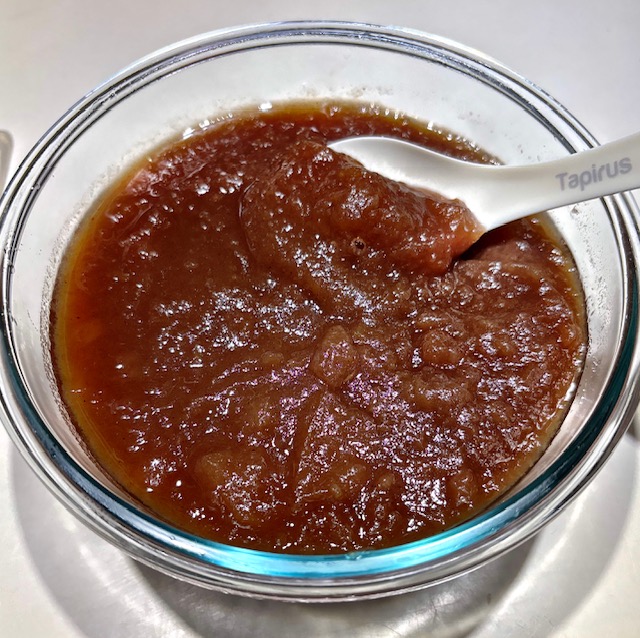
If you think you can’t make delicious homemade applesauce, this recipe will convince you otherwise. Simple, only a few ingredients, and very little mess to cleanup. You will need a slow-cooker but the reward is an awesome side dish and a sweet aroma which will fill your kitchen.
Equipment needed: Slow Cooker or Crockpot
[/recipe-ingredients]
Apples – 8 – peeled, cored and sliced thin
1/2 cup water
3/4 cup brown sugar, firmly packed
1 tsp Vanilla Sugar
1 tsp Cinnamon
[/recipe-ingredients]
[/recipe-directions]
Line slow cooker with a liner designed for crockpots and slow cooker. This makes cleanup super easy. Set Slow Cooker to LOW.
Peel, Core and slice apples thinly.
Add the apples, water, brown sugar, vanilla sugar and cinnamon into a medium bowl. Blend gently with a spoon. VANILLA SUGAR can be purchased at most large grocery stores or online. It is sold in either small packets or a small jar the size of spices.
I suggest lining the crockpot (slow cooker) with a plastic liner designed for that purpose. This makes the cleanup much easier..
Cook in crockpot for about 6 hours. Apples should have dissolved mostly into a sauce with chunks remaining. You may serve just like this and the apples will melt in your mouth. Or, use an immersion blender or scoop the sauce into an upright blender to create a smoother applesauce. Either way, serve warm.
Total time to prepare – Approximately 1 hour. Serves four (4).
This recipe is designed for the Ninja Speedi. This is an appetizer and the number of croquettes will depend upon the size of the zucchini and the size of the balls created.
Equipment needed: Ninja Speedi
[/recipe-ingredients]
Grated Zucchini – 1.5 cups
1/2 cup grated carrots
1/2 cup shredded Pepper Jack Cheese
Minced yellow onion – 2 Tbsp
All-purpose Flour – 1 Tbsp.
Cracker Meal – 1 Tbsp.
Unsalted Butter – 1Tbsp.
Egg, large – one (1) whisked
Salt – 1/4 tsp.
Pepper – 1/2 tsp.
Italian bread crumbs – 1 cup or more
Marinara sauce (for dipping)
[/recipe-ingredients]
[/recipe-directions]
Set Ninja Speedi to Air Fry, 350 degrees.
Squeeze grated zucchini between paper towels ro remove excess moisture and transfer to a large bowl. Allow zucchini to drain while remainder of ingredients are prepared.
Add shredded cheese, grated carrots, flour, cracker meal, butter, egg, salt, and pepper to stir to combine.
Pleace bread crumbs in a separate smaller bowl.
Form zucchini mixture into twelve (12) balls, about 2 tablespoons each. Roll each ball into bread crumbs. Make sure all sides are ocated.
Place half of croquettes onto the platform of the Ninja Speedi. Airfry for 6 minutes, including preheat time.
Flip croquettes and airfry for an additional 5-6 minutes. Transfer to a plate and repeat with remainder of croquettes.
In 1940, a Black minister held his eight-year-old son’s hand as they strolled through the turnstiles entering Ebbets Field. The child’s eyes opened wide as he absorbed the view of the bright lights, the dazzling white uniforms of the Brooklyn Dodgers, the sweet scent of newly manicured grass, and the buzz of nearly 32,000 fans.
At that moment, young Les Taylor pledged he would become a part of baseball. His family had survived the Great Depression, so he had a youthful understanding of hardship and some requirements of life ahead of him. But he promised himself he would find the time to play and improve his skills at the game he loved.
He returned to his home in Plainfield, New Jersey. Little League wasn’t yet available for America’s youth, so Les sought every opportunity to enjoy baseball in sandlot and pickup games. He was hooked, and baseball surrounded him. Through his father’s church, he got to know Joe Black, who earned National League Rookie-of-the-Year honors in 1952, then started and won a World Series game for the Brooklyn Dodgers that same year. While Les played tournament ball with the Georgia Crackers, he competed against Jake Wood, who later developed into the starting second baseman for the Detroit Tigers. Jake was the first Black player who came up through Detroit’s farm system when he began the 1961 season with the Motor City team.
As life often does, it interrupted his pursuit of baseball when he entered the Army. After serving his term, he attended North Carolina Central University, where he received his Bachelor of Arts degree in social science. By 1959, the Dodgers had moved to Los Angeles, leaving Ebbets Field vacant. Still, he felt the tugging allure of Brooklyn. It was there he married his college sweetheart, Carnell, and the couple settled near the former home of his beloved Dodgers, where they raised their four children over the next thirty-five years. For Les, even though a big league team was no longer in town, he always sensed baseball was in the air. Perhaps the spirits of early Dodger greats, such as Dazzy Vance and Branch Rickey, or the souls of some of the initial Black Major League players like Jackie Robinson and Roy Campanella, found their way back to their baseball home.
During that time, Les Taylor evolved from playing baseball to softball. He perfected the Brooklyn two-step, a hitter’s maneuver to take two quick strides to meet a sinking softball at a better height to send hard line drives into the outfield. Now, over a half-century later, he still has the occasion to use that same swing today.
He continued to play softball as often as possible, even while he held down two jobs and helped his wife, Carnell, raise their family. Les used his college degree and innate ability to guide people as he advanced in his career in social services. He became a teacher for the New York City Board of Education. As a second job, for eighteen years he was the Director of Pink Houses Senior Center. Of course, he still carved out time for softball, and was an active player and manager in the Social Services League.
He retired in 1992, purchased a home in the northern Atlanta suburbs where he and Carnell relocated in 1995. Shortly after they moved in, his wife sent him on an errand to a hardware store and Les stopped at a Publix supermarket on his way back. It was there he spotted a bulletin board with a note seeking anyone over fifty who might be interested in playing softball, stating they should inquire at nearby Hobgood Park. Once there, he discovered a few older guys playing a pickup game on a Little League diamond, and learned their names were Jerry and Bill King, not related. They invited him to play, and those days were the beginnings of the Cherokee Senior Softball Association (CSSA), and Les became instrumental in its development.
As Les helped that league grow, he was also active in traveling softball, where he played for many teams. It was there he met and played with Dorman Lane, a player with outstanding baseball knowledge who taught the intricacies of softball management to Les.
During his years on those traveling teams, Les felt he was privileged to play with and with several outstanding players, including Carl Brown, who remains active in the CSSA. While Les was a member of the Georgia Crackers Softball Team for over five years, he often encountered Howard Schoen, star second baseman of the Georgia Peaches.
2001 was a banner year for this young-at-heart senior player. His traveling team, with Carl Brown a member, competed in the AAA level of the 65+ tournaments. That year, his team won the three separate World Series of the ASA, USA and USSSA, a Triple Crown of senior softball. In the final game of what became the team’s third championship, Les drove in six runs with a double and a triple. In addition, the CSSA recognized Les’ overall contributions and performance for their organization, and honored him with the Arnold Fowler Award.
So here we are in 2023, and one can still watch this softball legend play in two leagues of the CSSA at Hobgood Park, twenty-eight years after its formation. Beyond that, think back to when Les began in organized softball, and realize he has passed his 60th year in uniform.
Following the lead of their preacher grandfather, two of Les’ four children have joined the ranks of the ministry. While three of his children live in the New York area and one in Detroit, it is a testimony to his devotion to his family that at least one of his offspring will often visit Les and Carnell here in Georgia. That sixty-three-year marriage has remained strong, with the four children adding ten grandchildren and three great grandchildren to the Taylor clan.
Throughout it all, with the occasional hiccup for human ailments, Les Taylor remains dedicated to the sport, which became part of his essence when the lights of Ebbets Fields illuminated his smiling face in 1940. Even now, at age 90, Les Taylor sits in the dugout after yet another contest and gazes out at the diamond with a wide grin. With a slight twinkle in his eye, he’ll look up at you and say, “Let’s play another one.”
Author’s note: It has been an honor to play with Les for the past two years. I can see his love for the game still glitters in his eyes. At age 91, he still hits the softball better than many players who are 30 years his junior. Amazing. He knows more about the game than I shall ever know, no matter how much I try to learn. Thank you, Les, for being a teammate, coach, inspirational leader, and friend of thousands of players.
If you asked Carl about the origins of baseball, he wouldn’t reply with that story about Abner Doubleday. Certainly not.
No, he would tell you baseball began in Summerville, Georgia, when an eight-year-old boy played on the street with his older brothers. First, you needed to find the right size rock, one that felt like you could toss it a fair distance and it might even roll a bit. Then, one brother would cover that rock with tarpaper and electrical tape, while the other grabbed an axe and strolled into the pine forest. When he returned with a tree suitable for whacking that rock, he would strip the bark, hack the wood to about three feet, and that was the birth of baseball.
One of those brothers played for the original Atlanta Crackers, and in 1948, Carl remembers visiting Cracker Field to cheer his brother and his team. He sat with Eddie Mathews and Chuck Tanner, future legends of baseball.
From those early days, Carl developed into an outstanding player, active in high school baseball, and soon developed into a traveling softball player. His wife, Shirley, encouraged his participation, and after 66 years of marriage, she remains an ardent supporter of Carl’s enthusiasm for the sport.
During that career, his team won the Softball World Series in Dallas, Texas, and over the years, he received several gold medals and awards for his defensive performances.
He and Shirley brought up a family where baseball is an integral part of their lives, and most of his clan played the sport at some organized level. The total count of their family is now at 3 children, 7 grandchildren, and 8 great-grandchildren.
But after all that, Carl’s heart still flutters just a little (thank goodness) when he thinks of all the boys, ages 8-16, who played baseball and he coached over thirty years. I’m willing to bet most of those athletes would remember Carl as that kind of soul who taught with the fervor and patience that captivates young men. If you talk with Carl now, you can still sense that gentleness within.
Carl is currently recovering from some elements of aging, but plans to return to the softball diamond this spring. He plays in the Cherokee County (Georgia) Senior Softball Association leagues at Hobgood Park in Woodstock, GA. Welcome Back, Carl. We miss you!
Total time to prepare – Approximately 1 hours, 35 minutes. Serves ten (10).
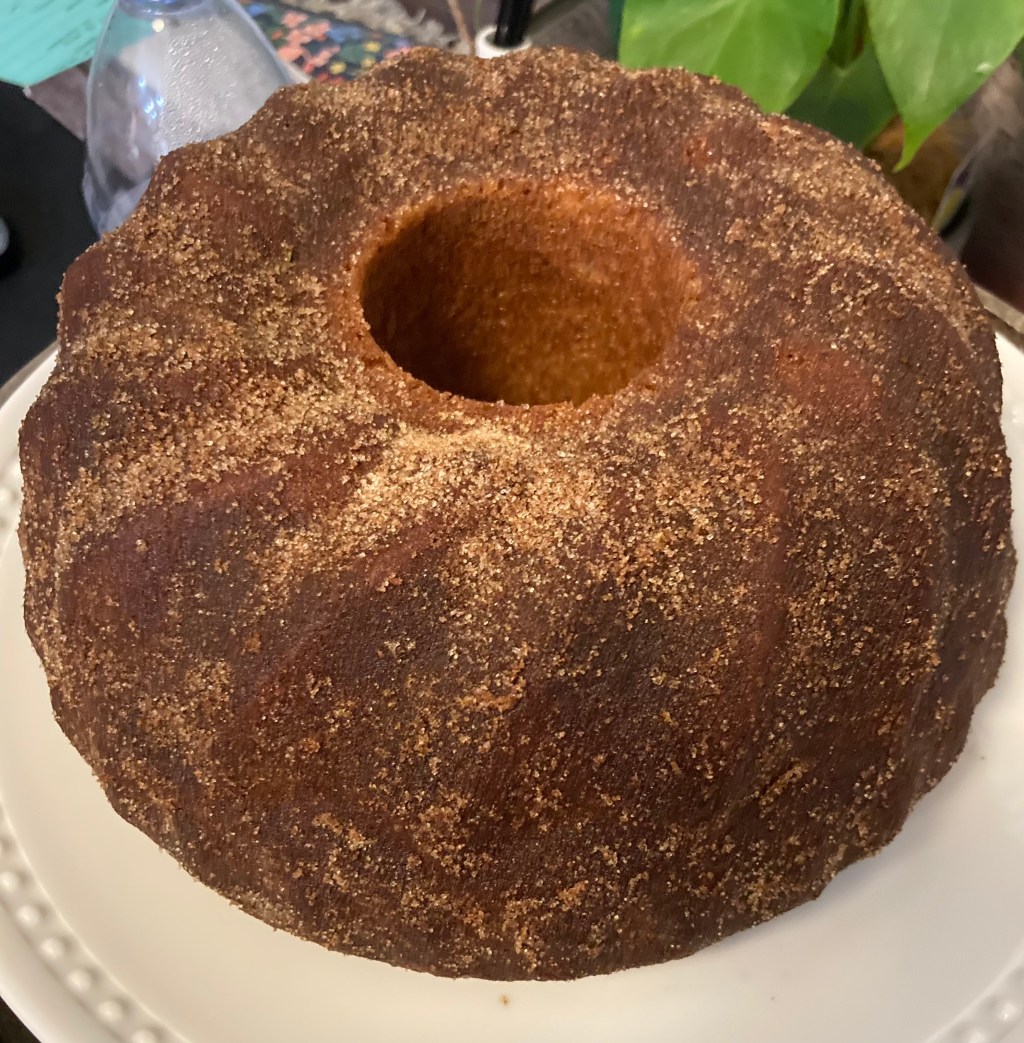
If you love apple-cider doughnuts from Farmer’s Markets, you’ll love this cake. Baked in a Bundt cake pan, it’s essentially a giant cake doughnut.Equipment needed: Bundt pan
[/recipe-ingredients]
Unsalted Butter, melted, Plus more for the pan – 2 Tbsp
Unbleached all-purpose flour, plus more for the pan – 2 cup
Whole wheat flour – 1 cup
Baking powder – 1.5 tsp
Baking soda – 1/2 tsp
Ground cinnamon – 1 Tbsp
Kosher salt – 3/4 tsp
Sugar – 1 3/4 cup
Apple cider – 1 cup
Extra-virgin olive oil – 3/4 cup
Unsweetened applesauce – 3/4 cup
Pure vanilla extract – 2 tsp
Eggs, large – 3
[/recipe-ingredients]
[/recipe-directions]
Preheat oven to 350 degrees.
Generously butter and flour a 12-cup Bundt pan.
In a large bowl, whisk together both flours, baking powder, cinnamon, baking soda, and salt.
In another bowl, whisk together 1.5 cups sugar, cider, oil, applesauce, vanilla, eggs.
Add egg mixture to flour mixture, whisk until combined.
Transfer batter to prepared pan.
Bake 45-50 minutes. Rotate pan halfway through until a test toothpick comes out clean.
Transfer pan to a wire rack over a rimmed baking sheet. Cool 15 minutes. Meanwhile, mix remaining 1/4 cup sugar and 1 tsp cinnamon.
Invert warm cake onto rack. Brush with melted butter. Then sprinkle liberally with cinnamon sugar.
Cool. Store cake covered, at room temperature, for up to two (2) days.ENJOY!







 Marty Aftewicz